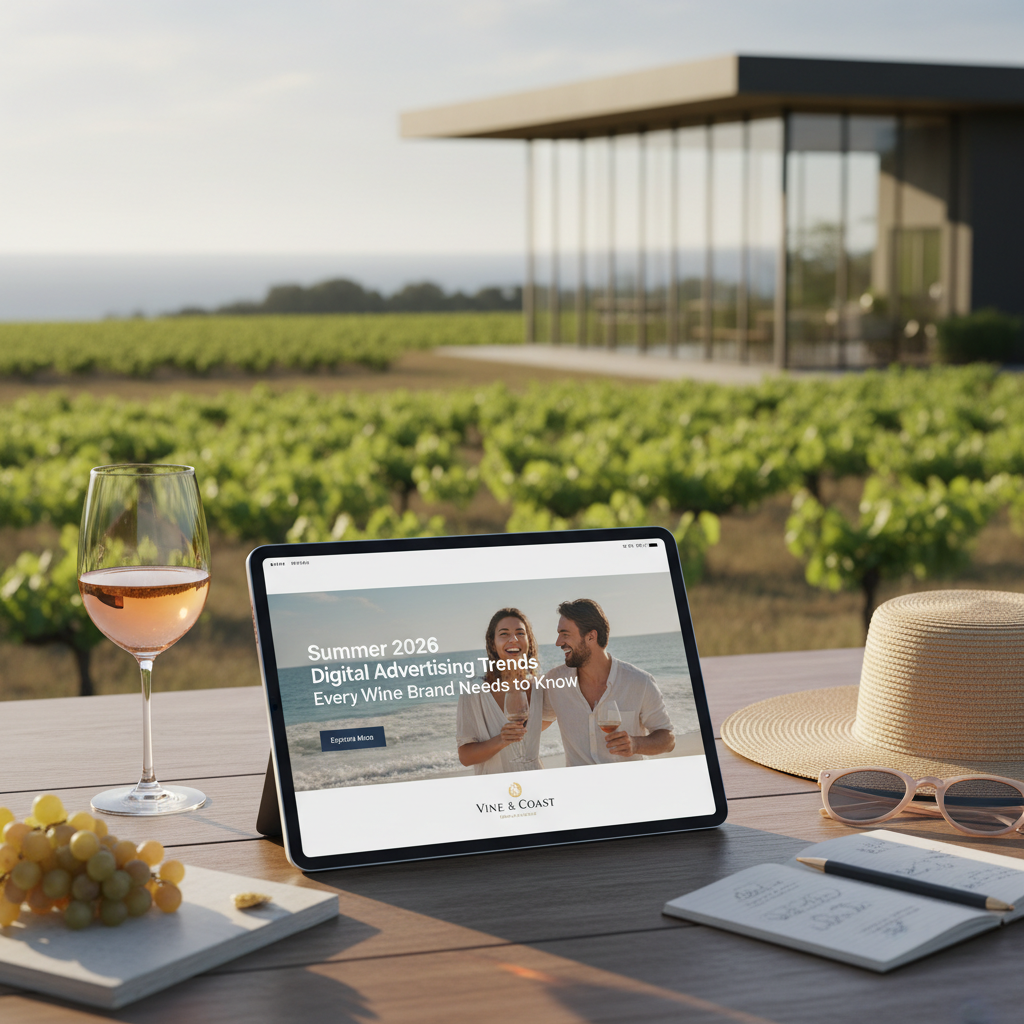
Summer 2026 Digital Advertising Trends Every Wine Brand Needs to Know
From AI-driven media planning to shifting regulations in the EU and booming demand in Japan, here's how smart wine brands are winning digitally this summer.
The Digital Landscape Has Shifted. Yes, Again
If your wine brand is still running the same digital playbook it used two summers ago, you're already behind. Summer 2026 arrives with a convergence of forces that are reshaping how wine is discovered, considered, and purchased online. Algorithmic media buying has matured, privacy regulations have tightened across three continents, and a new generation of high-intent wine consumers in Asia-Pacific is demanding content that meets them on their terms. The brands gaining ground right now are those treating digital advertising not as a broadcast channel, but as a precision instrument.
AI Media Planning Is No Longer Optional
The shift from rule-based ad targeting to AI-driven media planning is a present standard and no longer a future consideration. Platforms including Meta, Google's DV360, and emerging wine-adjacent programmatic networks now rely on machine-learning models to allocate spend dynamically across placements, audiences, and dayparts. For wine brands, this creates both an opportunity and a responsibility.
The opportunity: AI can identify micro-audiences, for example a Burgundy-curious consumers in their late thirties who regularly engage with restaurant content, with a precision no human media buyer could replicate at scale. The responsibility: your creative assets must be diverse enough to feed these systems. A single hero video and two static images will not give an AI model enough variation to optimise meaningfully. Best-in-class wine advertisers are now briefing creative teams to produce modular asset libraries including interchangeable headlines, visuals, and calls-to-action, so the algorithm can test and learn continuously throughout a campaign flight. This leads to instant optimisation.
The EU's Updated Alcohol Advertising Framework Is Reshaping Creative Strategy
In early 2026, the European Commission advanced its revised framework on alcohol marketing communications, tightening restrictions around placement near youth-facing content and mandating clearer responsible-drinking messaging across digital formats. For wine producers, négociants, merchants operating in France, Germany, Italy, and beyond, this is more than a compliance checkbox, it is a creative constraint that demands smarter storytelling.
The brands navigating this best are leaning into occasion-based narratives and lifestyle aspiration rather than leading with provenance and craft. In a recent case study, a Languedoc domaine reframed its summer campaign entirely around building emotional connection with consumers by leveraging the winemaker's voice and his family through a "Voyage in the Vines" series to convey their environmental philosophy and plant based food pairing recipes. We saw a more than 30% uplift in video completion rates compared to its previous lifestyle-led and terroir-led separate creative. Regulation, handled intelligently, can force a brand to communicate with more substance.
Japan: The Market That Rewards Patience and Precision
Japan continues its steady ascent as one of the most valuable premium wine markets in the world. Wine import value to Japan grew by approximately 8% in 2025, with French and Italian appellations leading, but ambitious New World producers from Chile, New Zealand, and South Africa are carving out real share through targeted digital investment.
What works in Japan is distinctly different from North America or Europe. LINE remains a dominant platform for brand communication, and Japanese consumers respond exceptionally well to long-form educational content such as tasting notes with cultural context, food pairing guides tailored to Japanese cuisine, and storytelling that respects the consumer's intelligence. In Japan, education is more than a basic marketing add-on, it's part of how consumers build trust, confidence and appreciation, particularly in specialist categories such as wine. Brands that localise superficially, ie translating copy without adapting the narrative logic, consistently underperform against those that invest in genuine cultural translation. If Japan is on your growth roadmap for 2026, your digital strategy needs a Japan-specific creative brief, not an adapted global one.
North America: Retail Media Networks Are the New Battleground
In the United States and Canada, retail media networks such as advertising ecosystems operated by major off-premise retailers and wine e-commerce platforms, have become the most contested real estate in wine digital marketing. Total Beverage Alcohol (TBA) retail media spend in North America is projected to exceed $400 million in 2026, with wine accounting for a growing proportion.
For producers and importers, the strategic implication is clear: proximity to the point of purchase now matters as much as brand-building reach. Sponsored placements within platforms like Vivino, Total Wine's digital ecosystem, and LCBO's online channels are delivering measurable last-mile conversion that traditional awareness campaigns cannot. The sophisticated approach is to layer retail media against upper-funnel brand investment. This means using broad reach campaigns to build desire, and retail media to close the sale, rather than treating them as competing budget lines.
First-Party Data Is Your Most Durable Asset
Across every market and platform, the deprecation of third-party cookies and the tightening of mobile identifier frameworks have made one thing unambiguously clear: the wine brands that own a direct relationship with their consumers will have a structural advantage throughout the rest of this decade. Wine clubs, direct e-commerce, tasting room email capture, and loyalty programmes need to be treated as data infrastructure rather than just a revenue channels.
Investing in clean, consented first-party data collected through compelling brand experiences is the single highest-return digital investment most wine brands are not making aggressively enough. Summer 2026 is an ideal activation window: high consumer engagement, strong gifting occasions, and seasonal content hooks that make sign-ups and subscriptions feel natural rather than transactional.
The Strategic Takeaway
The wine brands that will lead digitally into 2027 and beyond are those treating this summer not as a seasonal campaign moment, but as a strategic proof-of-concept. Test your AI creative frameworks now. Align with EU compliance proactively rather than reactively. Commit budget and cultural intelligence to Japan. Build your retail media presence in North America. And above all, treat your first-party audience as the asset it truly is. The digital shelf is getting more competitive by the quarter and the window to establish a durable advantage is open right now.
The next competitive advantage in wine will not belong to the brands shouting the loudest. It will belong to those who understand where attention is moving, how consumers are learning, and how to turn digital visibility into demand. If you want to build that advantage for your brand, book a strategy call with Steph AD-VIN CEO.

Stephanie Bouvard Moreton
Founder & CEO, AD-VIN · DipWSET · MW Stage 2 Candidate · 27+ years in global marketing & digital media strategy for the wine, alcohol, luxury and tech sectors. Learn more about AD-VIN.
Connect. Engage. Expand.
Interested in applying these ideas to your wine brand? Let's talk.
Book a Discovery CallAD-VIN Weekly
Wine marketing intelligence, every week.
Strategy, market trends, AI media insights — delivered to your inbox. Free.


Wine Demand Engine Scorecard
How exposed is your brand to AI-search traffic loss?
The Wine Demand Engine Scorecard includes a dedicated AI-search resilience assessment.
Start the scorecardFree. Practical. Built for wine brands, importers and distributors.